You noticed the inconsistencies, the defensiveness, the uncomfortable gap between what they promised and what they actually did. A quiet part of you was already saying: pay attention. And instead of examining that signal, you began explaining it away. They are kind. They have been hurt before. They need patience, understanding, more time. Slowly, those explanations became louder than the behaviour that created the discomfort in the first place.
This is not about blindly trusting every reaction. Fear can mislead us, and past wounds can colour how we read the present. The question here is more precise: why do we dismiss an internal warning even when it is connected to behaviour we have genuinely observed?
Why does something feel off when nothing is provably wrong? Watch this part · 1:43
A gut feeling in a relationship rarely arrives as a complete explanation. It does not organise the evidence, form a perfect argument and tell us what to do. It begins as discomfort. A pause after something they say. Tension when their actions do not match their promises. The sense that their kindness disappears whenever we express a need. The confusion after a conversation in which every question somehow became our fault.
Taken one by one, these moments look too small to justify a conclusion. But small does not mean meaningless. Our minds can register a pattern before we have found the language to describe it. That is what "something feels off but I don’t know what" usually is: not a mystery, but a repetition we have noticed and not yet named.
The feeling does not prove that our interpretation is correct. It tells us that something deserves closer attention.
Why do I ignore red flags I can clearly see?
Many of us make a crucial mistake at this stage. We believe we need undeniable proof before our discomfort is allowed to matter. So we dismiss it. We call ourselves oversensitive. We decide we are thinking too much. We focus on every pleasant moment and use it to discredit everything that made us hesitate.
But an internal warning does not always arrive to deliver a final verdict. Often it is only asking us to pause, look at what is actually happening, and stop giving trust faster than the other person’s behaviour has earned it. Ignoring a red flag is rarely a failure of eyesight. We saw it. We simply decided that seeing was not enough, and that we owed the relationship more evidence before we were allowed to feel what we felt.
Why accepting the feeling felt more dangerous than ignoring it Watch this part · 3:20
If the signal was there, why did we resist it? Because accepting it could have cost us something. It might have meant stepping back before we felt ready. It might have meant losing the future we had already begun imagining. It might have forced us to accept that this person would never become who we hoped they could be.
Once hope enters a relationship, we are no longer evaluating only the person in front of us. We are protecting a possibility. That possibility can contain the love we have wanted, the security we have missed, or the belief that all our patience will eventually mean something. And the question quietly changes. We stop asking what the behaviour is showing us, and start asking how we can explain it in a way that lets us stay.
They are a kind person underneath it all. They have suffered in the past. They are afraid of being vulnerable. They did not mean to hurt us. When they finally feel secure, things will change. Some of those explanations may be true. But they answer why someone behaves as they do. They do not tell us whether the relationship is emotionally safe, trustworthy, or right for us.
Hope becomes the defence lawyer for the relationship. Every warning is questioned. Every painful incident is given more context. Every good moment is used as evidence that the larger pattern should be forgiven. We do not override our judgement because we are weak or unable to see reality. Often we do it because reality is asking us to surrender something we are not emotionally ready to lose.
Is it intuition or relationship anxiety?
This is the question people ask most, and it deserves an honest answer: sometimes it is fear. An anxious feeling can look exactly like a gut feeling, especially after a relationship that hurt us. The difference is not in how strong the feeling is. It is in what the feeling is attached to.
Fear tends to point at possibilities: what they might do, what could happen, what happened last time with someone else. A gut feeling about this relationship points at things you have actually observed, and it keeps returning to the same ones. If you can name the behaviour, if it has happened more than once, and if raising it produced confusion rather than clarity, you are not dealing with a random anxiety. You are dealing with information.
When understanding them becomes a way of abandoning yourself Watch this part · 4:57
Compassion becomes dangerous when it is allowed to move in only one direction. We make room for their history, their wounds, their fears and their limitations. We make no room for the effect their behaviour is having on us. We become so focused on understanding why they hurt us that we stop asking why staying requires us to keep hurting ourselves.
We tell our friends this person is kind. We describe their potential. We explain the pain behind their actions. And without realising it, we stop describing the relationship as it exists and begin defending the reason we are still in it.
Understanding someone’s past provides context. It cannot turn inconsistency into reliability. An apology is not the same as repair. Good intentions are not the same as changed behaviour. Occasional tenderness does not erase a repeated pattern. And someone’s potential is not evidence of what they can give us now.
The more emotion, patience and hope we invest, the harder it becomes to return to what we noticed at the beginning. Because acknowledging it now would mean facing something painful: we did not need one final betrayal to understand the relationship. We already had the information. We kept demanding more evidence because the evidence we had was leading towards an answer we did not want. At that point we are no longer only doubting the other person. We are learning to doubt ourselves.
What to do with a gut feeling you can’t prove Watch this part · 6:38
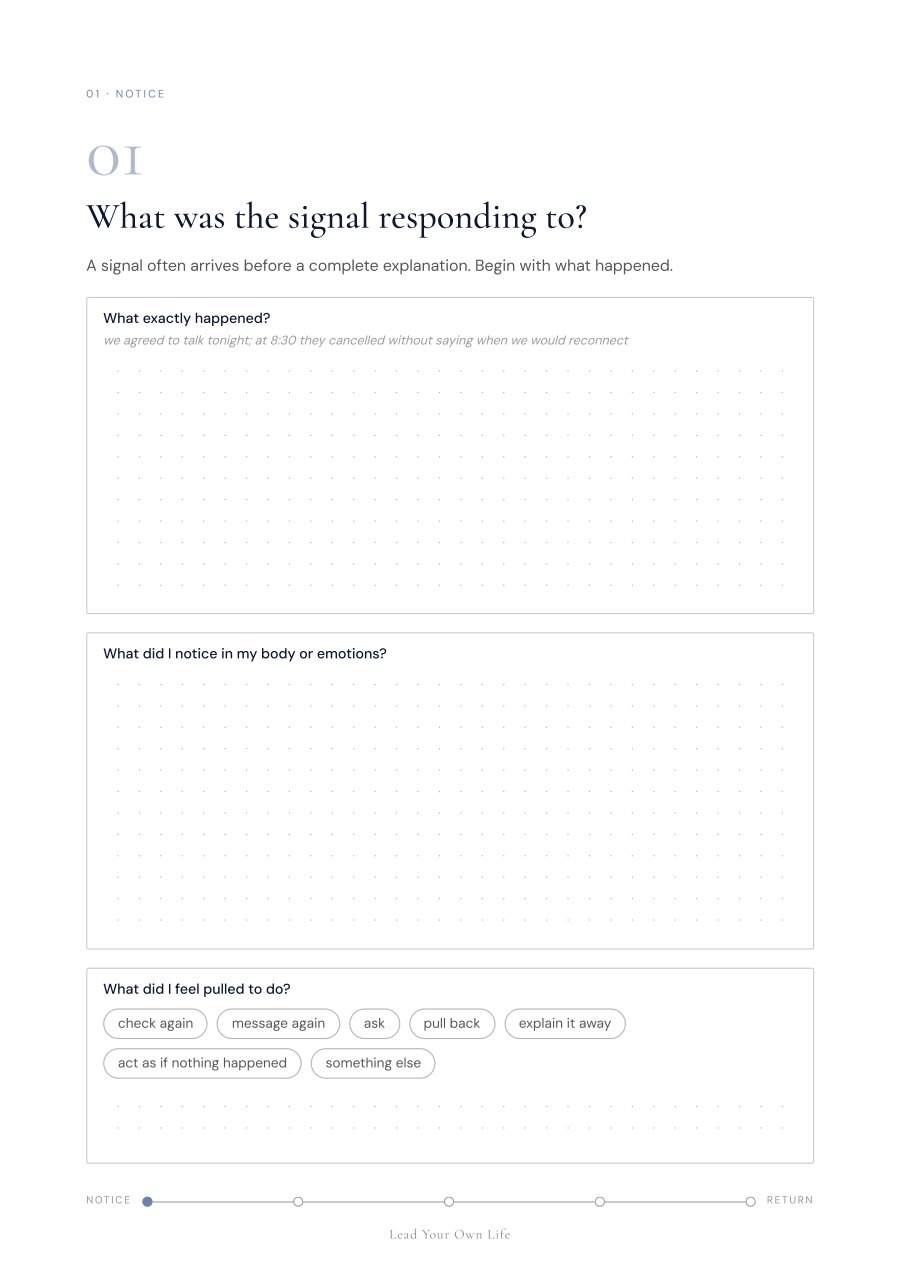
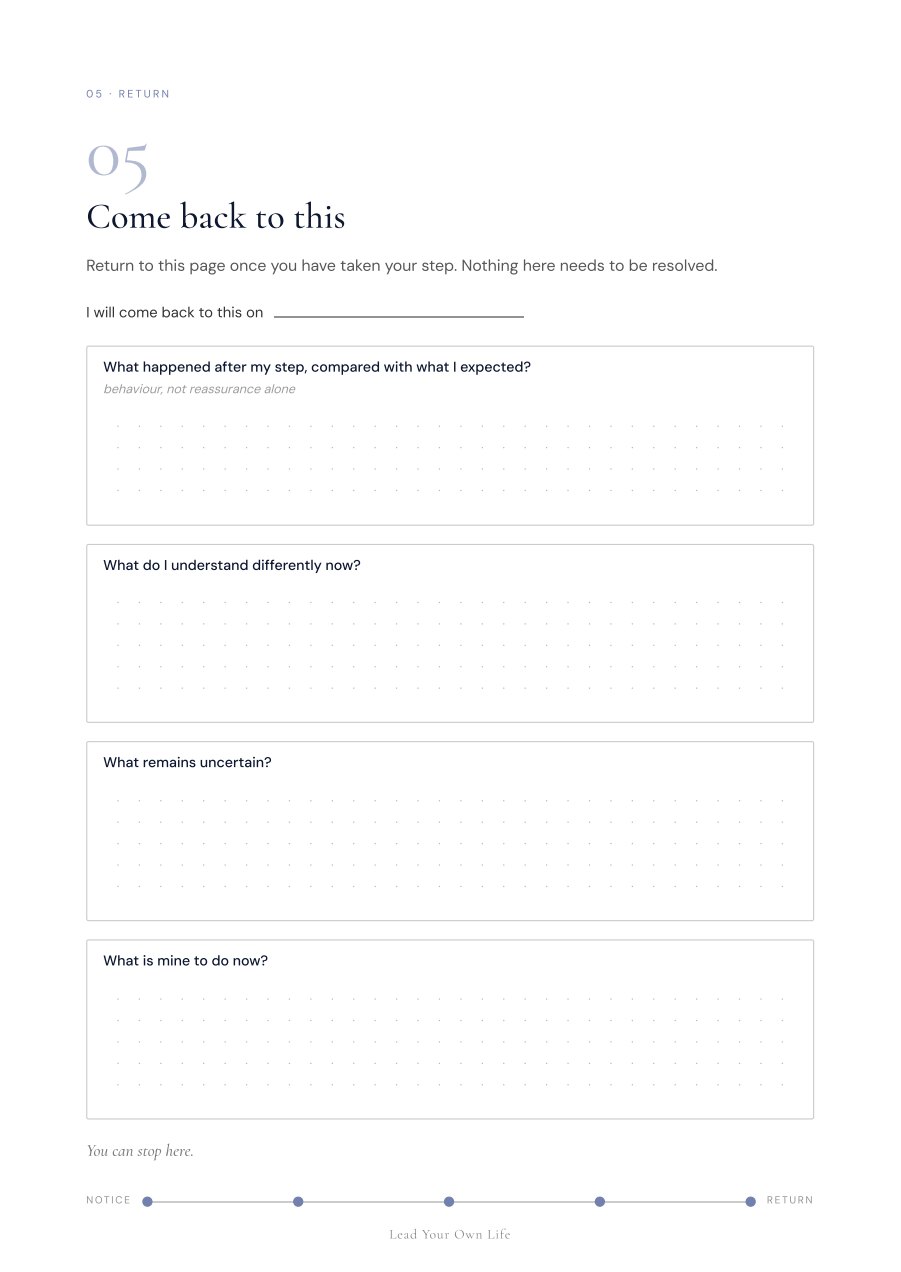
What to do with the feeling, the questions to translate it into, and how to let the answers matter: that part is in the video, from 6:38. The free guide Notice Your Inner Signal walks the same steps on paper.
Should you act on a gut feeling alone?
No, and you do not have to. A gut feeling is a reason to look, not a verdict to carry out. The hardest part is not discovering that our first feeling contained information. It is recognising how much effort we spent persuading ourselves not to examine it.
Self-trust begins to return when we stop asking hope to reinterpret repeated behaviour, and allow reality to speak for itself. We were not wrong for hoping. But we do not have to keep abandoning what we know in order to protect what we wish were true.