We already know the relationship is not treating us well. And still, we stay.
We see the inconsistency, and we notice how much we are waiting, adjusting and explaining. We know we would tell a friend not to accept the same treatment.
 Lead Your Own Life
We can already see what is wrong in the relationship. What we are waiting for is to be chosen.
We already know the relationship is not treating us well. And still, we stay.
We see the inconsistency, and we notice how much we are waiting, adjusting and explaining. We know we would tell a friend not to accept the same treatment.
In this pattern, the problem is not a lack of clarity. We already understand what is happening. What we are waiting for is a different ending, because if they finally choose us, everything we tolerated can start to feel as though it had a purpose. All that adjusting and explaining would have been leading somewhere.
That is where the relationship changes. We stop asking “Is this good for me?” and start asking “How do I become the person they choose?” The first question can be answered by looking at how we are treated. Only they can answer the second.
We are no longer just trying to build something with them. We are trying to use their choice as proof that we were worth choosing, and from then on, what they decide feels like a judgement on us.
At first, our attention is on them. Do their actions match their words? Do we feel respected? Can we express a need without being punished with distance? Is the effort mutual? Each question looks at their behaviour and at what the relationship is actually like.
Then their choice starts to feel connected to our worth, and the direction of judgement reverses. Instead of asking who they are, we start managing who we need to be: easier, more patient, less demanding, more desirable, harder to leave. A boundary begins to seem dangerous, and a need feels like a liability. Disappointment becomes something we hide, because we do not want it to cost us the relationship.
We stop learning who they are and start performing for the answer we want. The relationship becomes an audition, and in an audition only one side is being assessed. Underneath all of it, not being chosen has come to mean not being worth choosing, and that quietly shapes what we say, what we ask for and what we leave out.
The wish to be chosen grows with everything we have put in. It is also protected by how good we become at explaining away anything that threatens the outcome we are hoping for. The explanations come easily: that they are overwhelmed, that they need more time, that they struggle with closeness, that they care and simply do not know how to show it. Each might describe their behaviour accurately. But knowing why someone acts as they do does not change what it is like to be on the receiving end, and it leaves the central question untouched: how is this relationship actually treating us?
That is the question we put off, because the answer would mean admitting that the ending we wanted is not the ending we are living. It would also mean facing what we have already invested: the waiting, the excuses, the boundaries we moved, the needs we made smaller. So we keep hoping for one event that could justify everything that came before it, and that event is being chosen.
This is the uncomfortable part. We are not waiting for more information. We are waiting for their choice to make the price we paid feel worth it. And even if that choice finally comes, it answers far less than we want it to.
Being chosen is an event. Being treated well is a pattern. An event happens once, while a pattern is what keeps happening. They can choose us and still dismiss our needs, avoid responsibility, make honesty feel dangerous, or expect us to carry the emotional weight of the relationship.
Their choice does not rewrite the pattern. It confirms that they want the relationship on the terms already being offered. If those terms require us to shrink, wait, do more than our share, or silence ourselves, being chosen does not make the relationship healthy.
Being wanted feels powerful, and that is part of why their choice matters so much. But being wanted and being loved well are not the same experience. The first can arrive in a single moment. The second can only be seen in how the relationship treats us over time.
What happens if they finally give us exactly what we were waiting for? They choose us, the relief is enormous, and we feel wanted. For a while, the question of whether we are enough seems settled. But here is the trap. If their choice is the proof that we are worthy, their withdrawal becomes evidence that we are not. Their attention raises the score, and their distance lowers it.
That is why we keep needing their validation. A sense of worth that rises and falls with them can never be stable. And a stronger verdict in our favour would not change that, because whatever they give, they can take back. What keeps us stuck is not the verdict itself but the authority we have given it to measure our value. Once that authority is gone, we can look at the relationship without needing it to prove anything.
The video approaches this by taking their choice out of the equation. It asks us to imagine that they have chosen us once and for all: they want us, they are staying, and there is no competition, no rejection to reverse and nothing left to prove. What remains to look at is the relationship itself.
Then the video returns to the questions we started with. Do their actions match their words? Do we feel respected? Can we express a need without being punished with distance? Is the effort mutual? With nothing to win or lose, these questions are about the relationship again.
And it adds one more: do we feel more like ourselves, or have we spent so long becoming easier to choose that we stopped asking whether they were worthy of our choice? That question turns the audition around. It is about what we choose, not about being chosen, and it restores the judgement we gave up along the way.
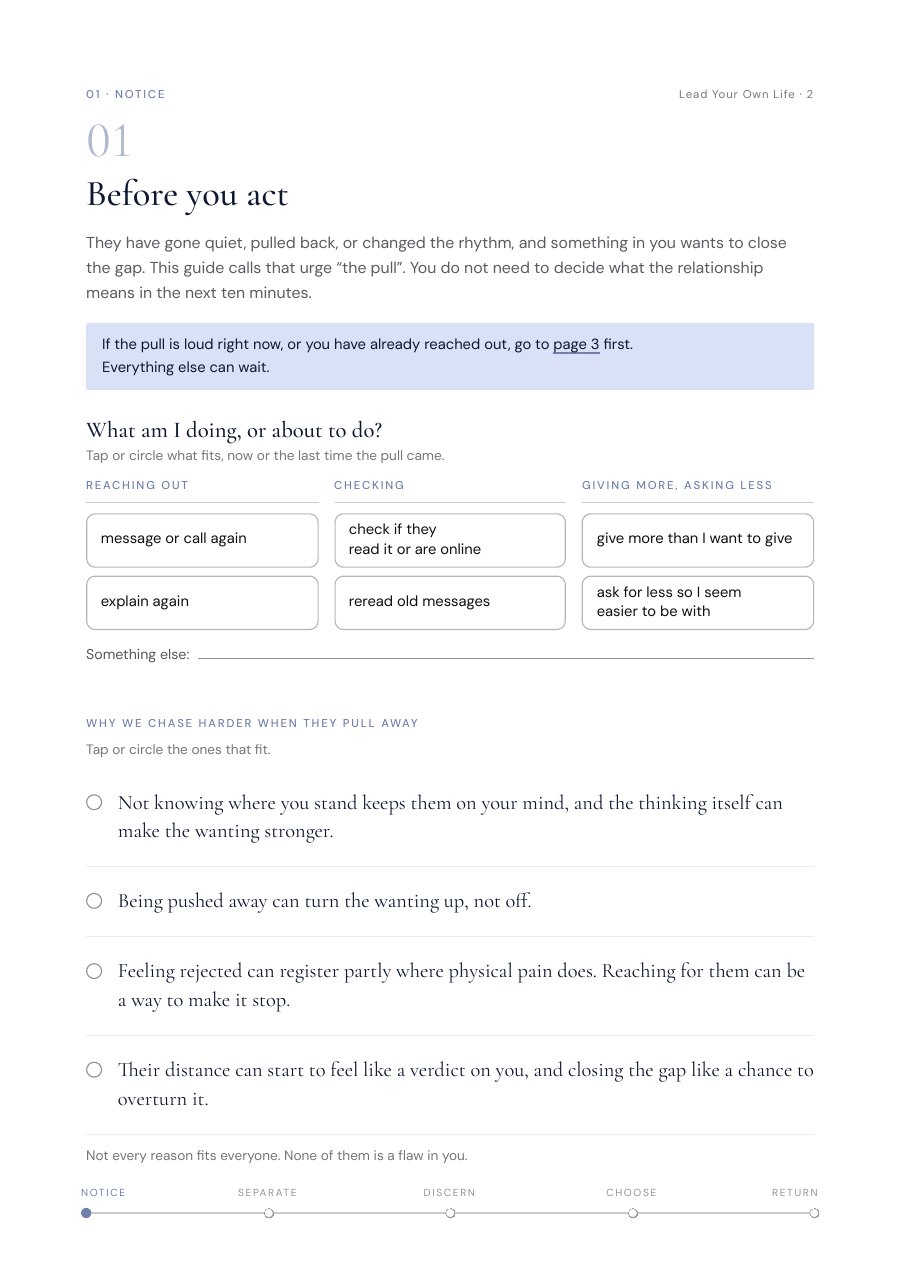
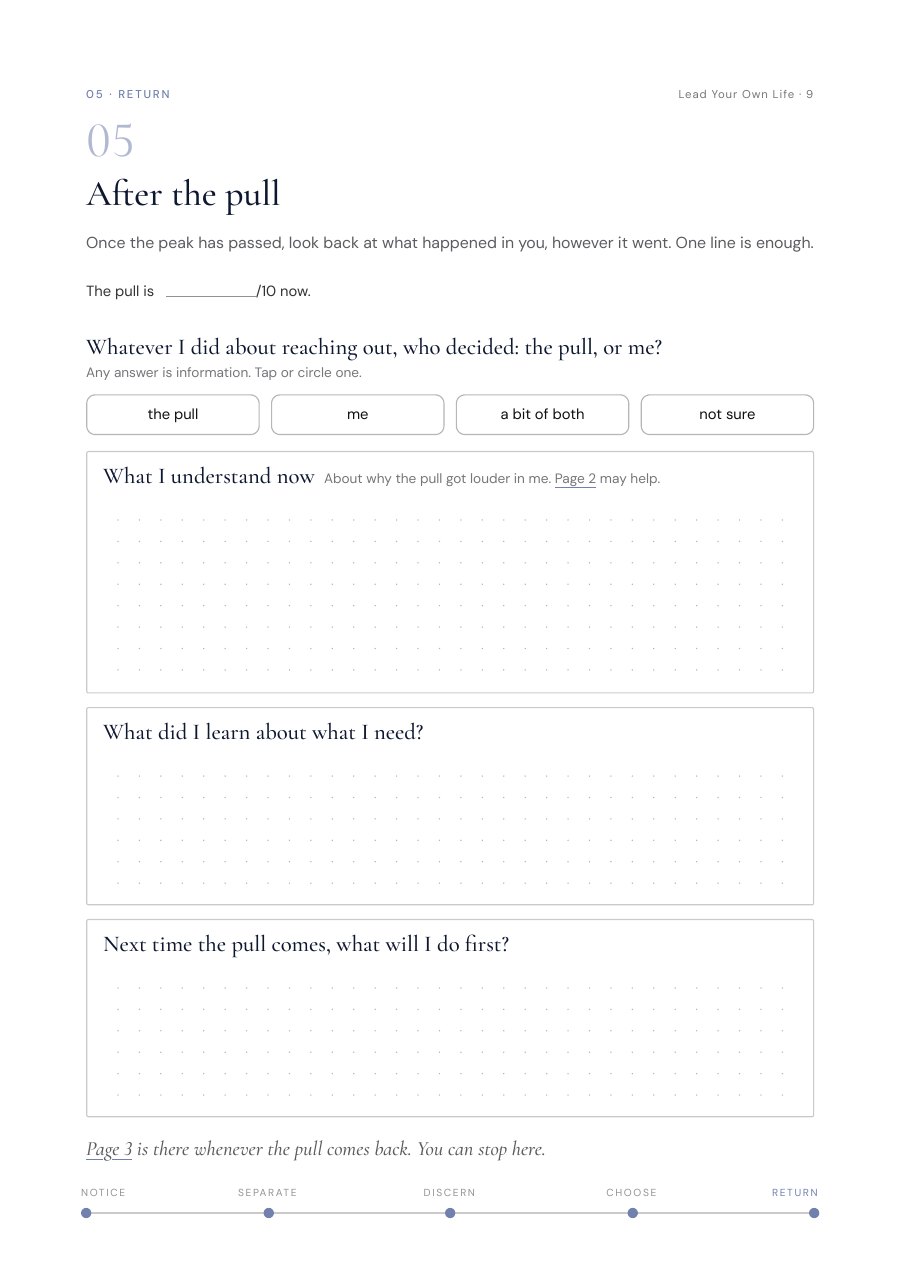
The free guide Before You Chase is made for the moment when they pull away and the urge to close the gap rises. On a phone or on paper, it makes a similar move: setting aside what is not in our hands, including what they will do next, and coming back to what is ours.
No. Wanting to be chosen is human. What the video reverses is not the wanting but the question, which moves from “How do I become the person they choose?” to “Knowing exactly what this relationship is, do I choose it?”
The trouble is how much we let their decision say about us. Another person’s choice cannot become the evidence that tells us whether we are enough, because once we hand them that authority, every change in their attention changes how we see ourselves. So the video does not ask us to stop wondering if they will choose us. It asks the question underneath: “If their choice proved nothing about my worth, would I still accept the way this relationship treats me?” Only we can answer it.
Their choice tells us what they want. Our choice tells us what we are willing to live with.
Free · 10 pages · PDF
They pull away, and something in you wants to close the gap.
The next move is still yours.